Osho Kundalini Meditation: Shake, Dance, Witness, and Return to Stillness
What Is Osho Kundalini Meditation?
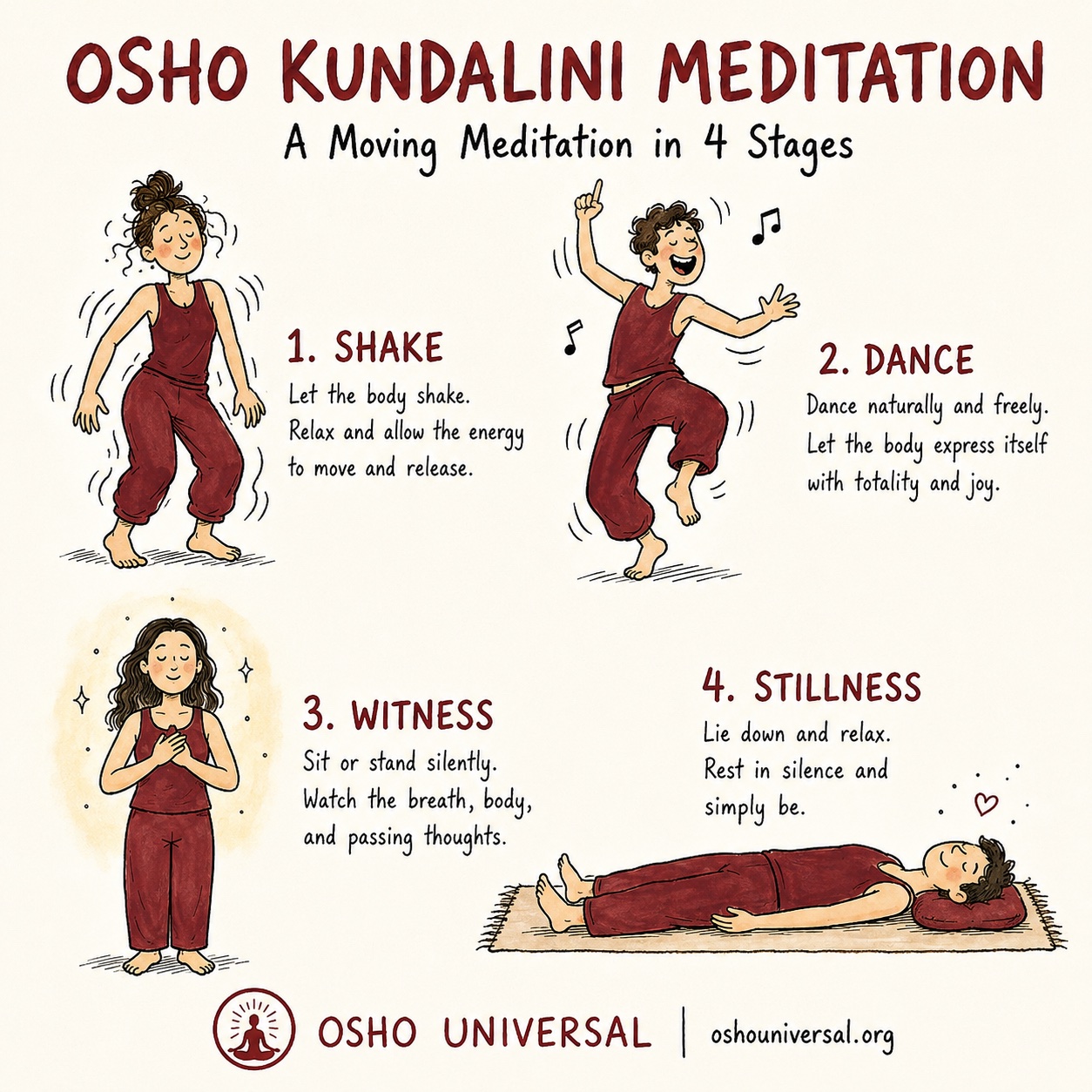
Osho Kundalini Meditation is a one-hour active meditation consisting of four stages of approximately 15 minutes each.
The meditation moves naturally through:
- Shaking
- Dancing
- Witnessing
- Stillness
The first two stages use movement to help the body release tension and stagnant energy. The final two stages invite awareness, silence, and relaxation.
The beauty of the meditation is that you do not have to fight the mind or force yourself to become peaceful.
You allow movement first.
Silence follows.
Osho's approach to meditation recognizes that modern human beings often carry tremendous physical, emotional, and mental activity. For many people, immediately sitting silently can feel difficult because the body and mind are still filled with unexpressed energy.
Kundalini Meditation begins exactly where we are.
Stage One: Shaking
For the first 15 minutes, stand comfortably and allow your whole body to shake.
Rather than deliberately performing the shaking, relax and allow it to happen. Feel the movement beginning naturally within the body.
Let the legs, hips, arms, shoulders, and entire body participate.
The important thing is not to control the experience.
Allow.
As the body shakes, tensions that have been unconsciously held may begin to loosen. Instead of analyzing what is happening, remain present with the sensations.
The shaking becomes a doorway.
The body moves, while awareness watches.
Stage Two: Dancing
For the next 15 minutes, allow the shaking to transform into dance.
There are no steps to remember.
There is no audience.
There is nothing to perform.
Let the body move in whatever way feels natural.
Dance with totality.
Sometimes the movement may be energetic and joyful. At other times it may be soft and gentle. The purpose is not to dance beautifully—it is to disappear into the dancing.
For these few minutes, allow the body to express itself without judgment.
Movement becomes meditation when the one who is moving is also aware.
Stage Three: Witnessing
After the intensity of movement comes stillness.
For the third stage, remain sitting or standing with your eyes closed.
Become completely still.
Now simply observe.
Notice your breathing.
Notice sensations in the body.
Notice thoughts coming and going.
Notice emotions without naming, judging, suppressing, or following them.
You are not trying to stop thoughts.
You are simply becoming the witness.
This witnessing is at the heart of meditation.
The body may be still.
The mind may continue moving.
But somewhere within, awareness simply watches.
Gradually, a distance can appear between you and everything passing through you.
Thoughts are there—but you are watching.
Emotions are there—but you are watching.
Sensations are there—but you are watching.
That silent witnessing opens the door toward meditation.
Stage Four: Stillness
In the final 15 minutes, lie down with your eyes closed.
Do nothing.
Let go completely.
There is nowhere to go and nothing to achieve.
The movement has finished.
The effort has finished.
Now simply rest in the silence that remains.
This final stage allows the experience of the previous stages to settle deeply into the body and awareness.
Sometimes the silence feels profound.
Sometimes thoughts remain.
Sometimes there is simply relaxation.
Whatever happens, allow it.
Meditation is not about demanding a particular experience.
It is about being present with what is.
Why Shaking?
Shaking may appear unusual to someone experiencing active meditation for the first time, but the body naturally uses movement to release tension.
Modern life teaches us to control ourselves constantly.
Control your emotions.
Control your body.
Control your reactions.
Control how others see you.
Over time, this control can create layers of tension.
During Kundalini Meditation, shaking provides an opportunity to temporarily stop controlling and allow the body to move freely.
Rather than trying to intellectually understand every emotion or tension, we allow the body to participate in releasing it.
The process can feel deeply refreshing.
From Doing to Non-Doing
Kundalini Meditation beautifully demonstrates a central paradox of meditation.
At first, there is action.
You shake.
You dance.
Then gradually, the action disappears.
You watch.
You rest.
The meditation moves from doing toward non-doing.
This transition is important because silence cannot always be forced directly.
Sometimes we need to move through our accumulated restlessness before discovering the stillness underneath it.
When movement is total, stillness can arise naturally.
The Art of Witnessing
The deepest dimension of Kundalini Meditation is not the shaking or the dancing.
It is awareness.
Throughout the meditation, there is an invitation to remain conscious of what is happening.
The body shakes.
Watch.
The body dances.
Watch.
Thoughts arise.
Watch.
Silence appears.
Watch.
The practice of witnessing gradually teaches us that we do not have to become identified with everything happening inside us.
A thought is simply a thought.
An emotion is simply an emotion.
A sensation is simply a sensation.
They arise.
They change.
They disappear.
Awareness remains.
When Is Osho Kundalini Meditation Practiced?
Osho Kundalini Meditation is traditionally practiced in the late afternoon or around sunset.
It can be particularly supportive after a busy day because it provides an opportunity to release accumulated tension before moving into the evening.
Many meditators experience it as a bridge between the activity of the day and the silence of the night.
Wear comfortable clothing, give yourself enough space to move freely, and approach the meditation without expectations.
If you are new to the practice, participating in a guided meditation session can help you understand its rhythm and structure.
There Is Nothing to Achieve
One of the most beautiful aspects of meditation is that there is no competition.
You cannot be better at meditation than someone else.
There is no perfect shaking.
There is no perfect dance.
There is no perfect silence.
Some days may feel energetic.
Some days may feel peaceful.
Some days the mind may remain busy.
Allow every experience.
The moment we begin chasing a particular state, meditation becomes another ambition.
Instead, Osho Kundalini Meditation invites us to participate totally and then simply witness whatever unfolds.
Experience Osho Kundalini Meditation at Osho Universal
Meditation becomes deeper when it is experienced rather than merely understood.
Reading about shaking is different from shaking.
Reading about dancing is different from disappearing into dance.
Reading about silence is different from entering silence.
At Osho Universal, we invite seekers, meditators, and anyone curious about inner transformation to experience Osho Kundalini Meditation with openness and awareness.
Come without expectations.
Bring your total energy to the movement.
Allow the body to shake.
Allow yourself to dance.
Then become silent.
And watch.
Perhaps beneath all the movement, thoughts, emotions, and noise, you may discover something that has always been present:
the silent witness within.
Osho Kundalini Meditation at a Glance
Duration: Approximately 60 minutes
Stage 1: 15 minutes — Shaking
Stage 2: 15 minutes — Dancing
Stage 3: 15 minutes — Sitting or standing in silent witnessing
Stage 4: 15 minutes — Lying down in stillness
Suggested time: Late afternoon or around sunset.